When people search for bat population by state, they often expect a table showing the exact number of bats living in every state. The reality is more complicated. The United States does not have a complete annual census counting every individual bat, so reliable information is usually available as species diversity, colony counts, hibernacula surveys, or estimates for individual species rather than a single population number for each state.
Texas stands out for bat diversity, with the Texas Parks and Wildlife Department reporting 32 of the 47 bat species found in the United States. The state is also home to Bracken Cave, one of the world’s most spectacular bat colonies.
Other states are important because they contain major maternity colonies, hibernation sites, migratory routes, endangered species, or protected bat habitats.
What Does “Bat Population by State” Actually Mean?
Bat population by state can refer to either the number of individual bats or the number of bat species recorded in a state. Those are two very different measurements.
For example, a state may have relatively few species but contain an enormous seasonal colony. Another state may support many species but have populations spread across forests, buildings, caves and other habitats.
Researchers commonly measure bats through:
- Cave and mine hibernacula surveys
- Maternity colony counts
- Acoustic monitoring
- Roost surveys
- Capture and recapture studies
- Winter population estimates
- Migration monitoring
- Species distribution records
The U.S. Fish & Wildlife Service warns that even species-specific population estimates can contain uncertainty because bats may use undocumented winter sites and detection methods can vary between locations.
That is why a simple “number of bats per state” ranking can be misleading.
Which U.S. States Have the Most Bats?
Texas is the leading state for bat species diversity, with 32 species currently reported by Texas Parks and Wildlife.
Texas benefits from its enormous size and variety of ecosystems, including deserts, forests, grasslands, coastal areas, caves and urban environments. This gives many native bat species suitable places to feed, roost and reproduce.
Other states are also especially important for American bats because of their caves, forests and migration corridors.
Bat Diversity vs. Bat Population
It is important to separate these concepts:
| Measurement | What it tells us |
|---|---|
| Species diversity | How many different bat species occur in a state |
| Colony size | How many bats occupy a particular roost |
| Hibernacula count | Number of bats counted during winter |
| Maternity colony | Reproductive bats and young at a summer site |
| Population estimate | Scientific estimate for a particular species or region |
| Distribution | Where a species has been recorded |
This means the state with the most bat species is not necessarily the state with the most individual bats.
Bat Population by State in 2026
The following states and district are particularly notable when discussing U.S. bat populations, species and official bat symbols.
Texas
Texas is the standout state for bat diversity in the United States. Texas Parks and Wildlife reports 32 bat species, making the state an exceptional center for American bat wildlife.
Texas is also famous for enormous Mexican free-tailed bat colonies.
The Mexican free-tailed bat (Tadarida brasiliensis) has been Texas’ official state flying mammal since 1995. Texas Parks and Wildlife notes that about 100 million Mexican free-tailed bats spend the summer in the Texas Hill Country.
Major bat-watching locations include:
- Bracken Cave near San Antonio
- Congress Avenue Bridge in Austin
- Old Tunnel Wildlife Management Area
- Kickapoo Cavern State Park
- Devil’s Sinkhole State Natural Area
Bracken Cave is particularly famous for its huge seasonal colony, while Congress Avenue Bridge is one of the best-known urban bat-viewing locations in the country.
Texas bats also provide agricultural pest control. Texas Parks and Wildlife reports research showing substantial economic benefits from bats consuming crop pests.
California
California has a highly diverse landscape, ranging from deserts and mountains to forests, agricultural regions and coastal ecosystems.
The state also has an official bat: the pallid bat (Antrozous pallidus).
California established the pallid bat as its official state bat through Senate Bill 732. The legislation was chaptered in 2023, with the designation becoming effective January 1, 2024.
The choice reflects the ecological importance of bats in California. Pallid bats and other species consume insects and contribute to natural pest control.
The California Legislature’s analysis of SB 732 highlighted bats’ contributions to pest control, public health and ecosystem functions.
California is therefore important not simply because of the number of bats found there, but because of the variety of habitats supporting different bat species.
Virginia
Virginia is another important state for bat conservation, particularly for cave-dwelling species.
The state’s official bat is the Virginia big-eared bat (Corynorhinus townsendii virginianus). Virginia’s official code specifically identifies the Virginia big-eared bat as the Commonwealth’s bat emblem.
Virginia is home to multiple bat species, including cave bats and tree-roosting bats. The Virginia Department of Conservation and Recreation notes that the Virginia big-eared bat is rare and occurs in only a limited number of counties and caves.
The state’s bat populations have been heavily affected by white-nose syndrome, making Virginia an important example of why population trends need to be considered alongside conservation status.
Oklahoma
Oklahoma officially designated the Mexican free-tailed bat as its state flying mammal in 2006. State law identifies Tadarida brasiliensis as the official state flying mammal.
The decision was also connected with tourism and the Selman Bat Cave Wildlife Management Area. The Oklahoma Senate described the cave as a destination where visitors can watch bats emerge during the summer.
Oklahoma is particularly interesting because it demonstrates how bat caves can serve several purposes at once:
- Wildlife habitat
- Maternity sites
- Conservation areas
- Research locations
- Educational destinations
- Wildlife tourism attractions
Washington, D.C.
Washington, D.C. is not a state, but it has an official bat-related mammal designation.
The big brown bat (Eptesicus fuscus) was designated the official state mammal of the District of Columbia under D.C. Law 23-160, effective December 23, 2020.
The D.C. law notes that the big brown bat occurs throughout the United States, including the District, and uses echolocation to hunt insects.
This designation also highlights an important point: bats are not only cave animals. Species such as the big brown bat can live and forage around human-developed environments.
Comparing Bat Populations Across States
There is no scientifically sound 2026 ranking of every state by total individual bat population.
Instead, researchers rely on species-specific and site-specific monitoring.
For example, the Indiana bat provides one of the clearest examples of detailed population monitoring. A 2024 U.S. Fish & Wildlife Service estimate placed the range-wide Indiana bat population at 631,786 bats, distributed across 194 hibernacula in 15 states. Missouri, Indiana and Illinois contained the largest state totals in that survey.
This illustrates why species-level surveys are more useful than trying to create one giant national bat count.
Why State Rankings Are Difficult
Bat populations change throughout the year because many species migrate.
A state can have:
- Large summer colonies
- Smaller winter populations
- Migrating bats passing through
- Maternity colonies
- Hibernating bats
- Several species with completely different seasonal patterns
Therefore, a population number from January cannot necessarily be compared directly with a summer colony count.
Which States Have an Official State Bat?
As of 2026, four U.S. states plus Washington, D.C. have official bat designations commonly recognized in state or district law.
| State/District | Official bat | Designation |
|---|---|---|
| Texas | Mexican free-tailed bat | State flying mammal |
| Virginia | Virginia big-eared bat | State bat |
| Oklahoma | Mexican free-tailed bat | State flying mammal |
| California | Pallid bat | Official state bat |
| Washington, D.C. | Big brown bat | Official state mammal |
Texas selected the Mexican free-tailed bat in 1995, while Oklahoma adopted the same species as its official flying mammal in 2006.
Virginia’s code identifies the Virginia big-eared bat as its official bat.
California’s pallid bat designation was established through 2023 legislation.
D.C. selected the big brown bat as its official mammal in 2020.
How Many Bats Are There in the United States?
There is no reliable single number for every individual bat living in the United States.
The country is home to 47 recognized bat species according to Texas Parks and Wildlife’s national comparison, but that figure represents species diversity rather than total population.
Counting every individual bat would be extremely difficult because bats:
- Move between states
- Migrate seasonally
- Hibernate in inaccessible caves and mines
- Roost in trees and buildings
- Form colonies that change size
- May use undocumented roosting locations
Instead, agencies monitor individual species and important colonies.
For example, the U.S. Fish & Wildlife Service maintains detailed population estimates for endangered and threatened bats such as the Indiana bat and northern long-eared bat.
Bat Population Trends in the U.S.
The overall conservation picture is mixed.
Some large colonies remain spectacularly abundant, particularly in parts of the southern and western United States. However, several cave-dwelling species have suffered severe losses from white-nose syndrome (WNS).
The U.S. Fish & Wildlife Service says white-nose syndrome has caused major declines in multiple bat species. For the northern long-eared bat, estimated declines across its range reached 97% to 100% based on hibernacula counts.
The tricolored bat has also experienced severe losses at affected winter colonies, with the Fish & Wildlife Service reporting declines of 90% to 100% at impacted sites.
These figures demonstrate why simply asking which state has the most bats does not tell the whole conservation story.
What Is Driving Bat Population Declines?
Major threats include:
- White-nose syndrome
- Habitat loss
- Disturbance of caves and mines
- Loss of summer roosting habitat
- Wind-energy mortality
- Climate-related changes
- Human disturbance of maternity and hibernation sites
The Fish & Wildlife Service identifies habitat loss, wind energy and white-nose syndrome among the major threats facing North American bats.
Why Are Bats Important to the U.S. Ecosystem?
Bats provide valuable ecological services, especially insect control.
Many American bats consume large quantities of insects, including agricultural pests. Mexican free-tailed bats are particularly important in Texas agricultural landscapes.
Bats can contribute to:
- Natural pest control
- Agricultural productivity
- Forest ecosystem health
- Pollination
- Seed dispersal
- Nutrient cycling
- Biodiversity
Their economic value can also be significant. California legislation supporting the pallid bat designation specifically highlighted bats’ role in pest control and ecosystem health.
This is why protecting bat habitats is not simply about preserving a single group of wildlife. It can also support agriculture and broader ecosystem stability.
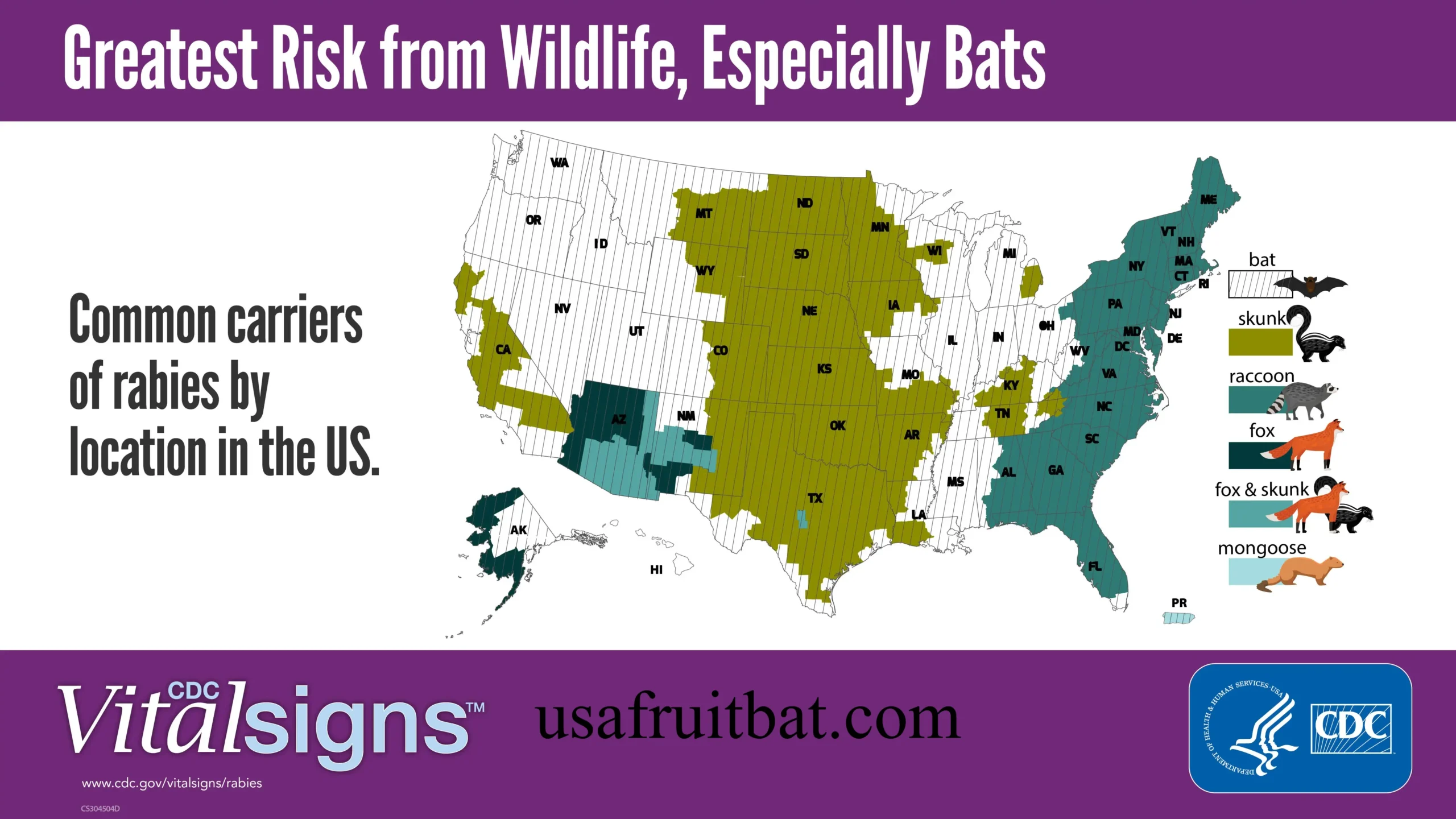
How to Read a Bat Distribution Map
A bat distribution map usually shows where a species has been documented, not how many bats live in each location.
For example, a map may show:
- Summer range
- Winter range
- Migration routes
- Breeding areas
- Hibernation sites
- Confirmed observations
Distribution and population should therefore never be treated as identical measurements.
A state shaded heavily on a map may contain suitable habitat without supporting a large population.
Frequently Asked Questions
What types of bats are found in America?
The United States has dozens of native bat species, including Mexican free-tailed bats, big brown bats, little brown bats, pallid bats, Indiana bats, gray bats, Virginia big-eared bats and northern long-eared bats. The exact species found depends heavily on geography and habitat.
What country has the most bats?
There is no universally accepted ranking based on the total number of individual bats because nationwide bat populations are difficult to census. Countries with large geographic areas and high bat diversity can support substantial bat populations, but comparisons depend on whether the measurement is species count, abundance or distribution.
What are European bats?
European bats are bat species native to Europe. They include several species of Myotis, Pipistrellus, Rhinolophus and other genera. Their ecology differs by species, with many relying heavily on forests, caves, buildings and other roosting habitats.
What is a big brown bat?
The big brown bat (Eptesicus fuscus) is a widespread North American insect-eating bat. It is also the official mammal of Washington, D.C. The district’s law notes that it uses echolocation to locate insects such as beetles, moths and flies.
What types of bats are in the United States?
U.S. bats include free-tailed bats, myotis bats, big-eared bats, brown bats, pallid bats, hoary bats and several other groups. Texas alone supports 32 of the 47 U.S. bat species cited by Texas Parks and Wildlife.
Which states have official bats?
Four states—Texas, Virginia, Oklahoma and California—have official bat designations, while Washington, D.C. has designated the big brown bat as its official state mammal.
Where can I find a bat distribution map?
The U.S. Fish & Wildlife Service’s species resources and individual species pages are useful starting points for examining ranges and conservation information. Distribution maps should be interpreted as species-range information rather than exact population counts.
Are American bat populations increasing or decreasing?
The answer varies by species and location. Some colonies remain extremely large, while several cave-dwelling species have suffered dramatic declines because of white-nose syndrome. The northern long-eared bat and tricolored bat are among the species facing particularly serious conservation challenges.
About the Author: Hamid is a wildlife writer covering bats, animal species, habitats, and conservation.
He creates clear, research-based guides to help readers understand wildlife and biodiversity.
Author Name: Hamid Ali
Email: johanharwen314@gmail.com
Also Read: