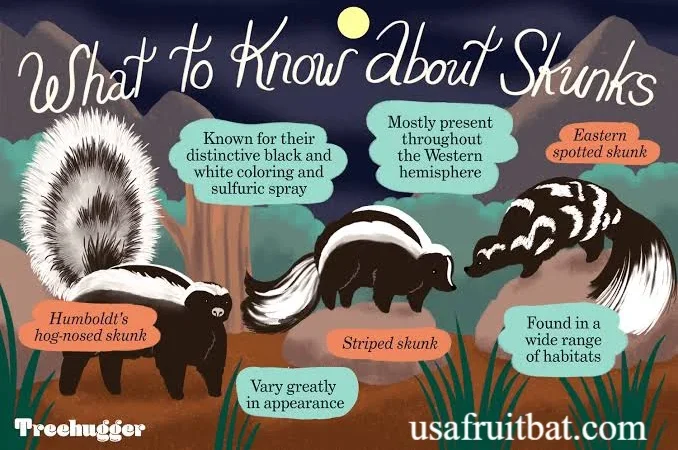
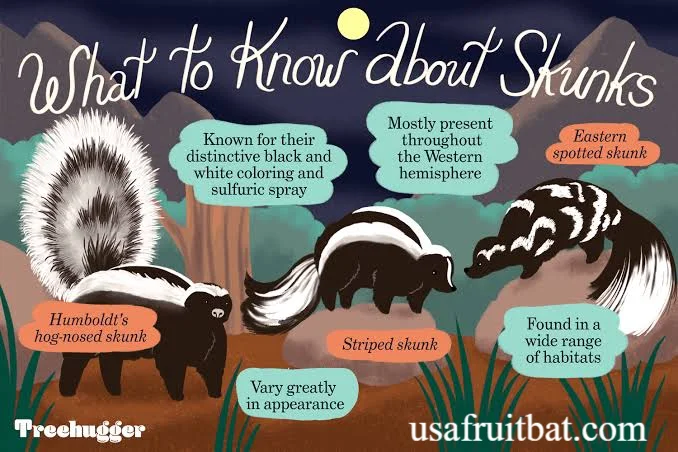
There are 12 species in the skunk family (Mephitidae), split across four groups: striped, spotted, hog-nosed and stink badgers. Ten live in the Americas, and two live in Southeast Asia. The four most people will ever encounter in the United States are the striped skunk, the spotted skunk, the hooded skunk and the hog-nosed skunk. Below is how to tell them apart, where they live, and what their behavior means if one turns up near your home.
How Many Types of Skunks Are There?
Short answer: 12 species in four genera, though taxonomists still debate the exact count of spotted skunks.
Skunks used to be filed under the weasel family (Mustelidae). Genetic work in the early 2000s moved them into their own family, Mephitidae, alongside the stink badgers of Asia. The groups are:
- Striped skunks (genus Mephitis): 2 species, the striped and the hooded skunk
- Spotted skunks (genus Spilogale): about 4 species, depending on the classification you follow
- Hog-nosed skunks (genus Conepatus): 4 species across the Americas
- Stink badgers (genus Mydaus): 2 species, in Indonesia, Malaysia and the Philippines
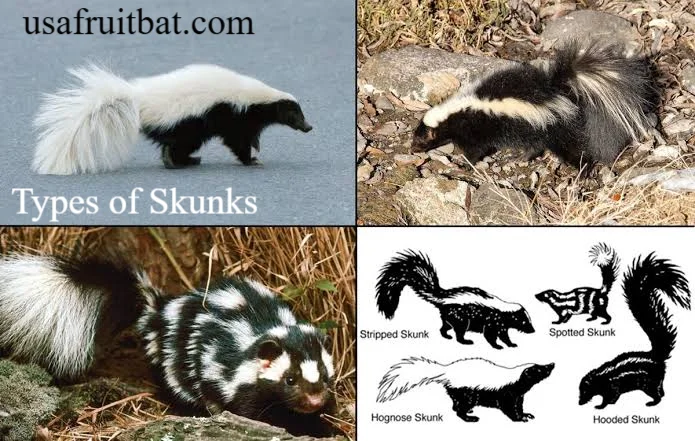
What Are the Main Skunk Species in North America?
North America has several skunk species, and their ranges overlap in places, especially across Texas and the Southwest.
Striped Skunk (Mephitis mephitis)
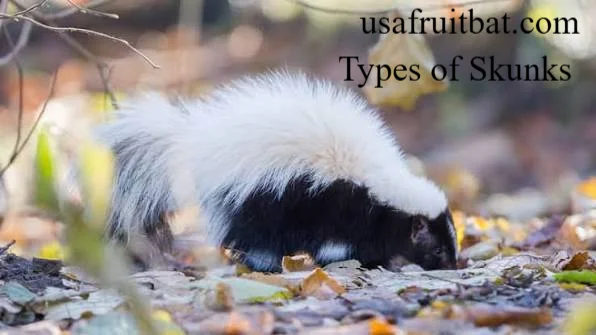
The most common and widespread skunk in the US. It is roughly house-cat sized, with a black body, a white patch on the head, and two white stripes running down the back that often join near the shoulders. The tail is bushy and usually black with white streaks.
It ranges from southern Canada across nearly all of the lower 48 states into northern Mexico. It is highly adaptable, living in forests, prairies, farmland and suburbs. It is an omnivore that eats insects, grubs, eggs, small mammals, fruit and garbage. It usually dens in burrows dug by other animals, or under decks, sheds and porches.
Spotted Skunk (Spilogale species)
Smaller, more weasel-like, and better at climbing. Instead of two long stripes, a spotted skunk has broken white stripes and patches that look like spots, plus a white spot on the forehead.
- Eastern spotted skunk (S. putorius): Found from the Great Plains east through the Appalachians and into Florida. Populations have declined in parts of its range, and the IUCN lists it as Vulnerable.
- Western spotted skunk (S. gracilis): Found across the western US, into southwestern Canada and northern Mexico.
- Pygmy spotted skunk (S. pygmaea): A tiny species restricted to Mexico’s Pacific coast, considered at risk.
The eastern spotted skunk is known to use trees and rocky ground for dens, unlike the striped skunk. It is also famous for a handstand-style warning display.
Hooded Skunk (Mephitis macroura)
A long-tailed skunk of the Southwest and Central America. Its tail is often as long as or longer than its body, and it usually appears mostly white. It gets its name from a ruff of longer fur around the neck. The color pattern varies: some have two stripes, some one wide stripe, and some are nearly all white.
Its range runs from the US Southwest (parts of Arizona, New Mexico and Texas) south through Mexico into Central America. In the US it favors rocky canyons, desert scrub and brushy areas near water.
Hog-Nosed Skunk (Conepatus species)
Easy to spot by its bare, piglike snout and mostly white back. Hog-nosed skunks have a thick body, short fur, and a broad white back and tail rather than two narrow stripes. They root through soil for grubs and insects, using strong claws.
The American hog-nosed skunk reaches into southern Texas and parts of the Southwest and Mexico. Three related species live in South America.
What Types of Skunks Live in South America and Asia?
South America’s skunks are all hog-nosed skunks. Molina’s hog-nosed skunk has a wide range that includes Chile, Argentina and Uruguay and reaches into Bolivia, Peru and southern Brazil. Humboldt’s hog-nosed skunk lives in Patagonia. The striped hog-nosed skunk lives further north along the Andes.
The two stink badgers, the Sunda and Palawan stink badgers, are skunk relatives found only in Southeast Asia. They look more like small badgers, but they share the family’s defensive spray.
How Do You Tell Skunk Species Apart?
Check three things: body size, pattern, and location.
| Species | Pattern | Size and shape | Typical range |
|---|---|---|---|
| Striped skunk | Two white stripes, white head cap | House-cat sized, bushy tail | Nearly all of the US, southern Canada |
| Eastern/western spotted | Broken stripes and spots | Small, slender | Eastern and western US (respectively) |
| Hooded skunk | One or two stripes, or mostly white; neck ruff | Very long tail | Southwestern US to Central America |
| Hog-nosed skunk | Broad white back and tail | Stocky, bare snout | Southern Texas, Southwest, South America |
A practical shortcut: if it climbs a tree, it’s most likely a spotted skunk. If you see a long tail and a hood-like ruff in Arizona or New Mexico, think hooded. If you see a bare snout and a mostly solid white back, think hog-nosed. In most of the US, the answer is usually a striped skunk.
Original insight: most “unusual skunk” sightings are the same striped skunk with a narrower or broken stripe pattern. Individual variation is common, so location and body shape are more reliable than pattern alone.
Do All Skunks Have Stripes?
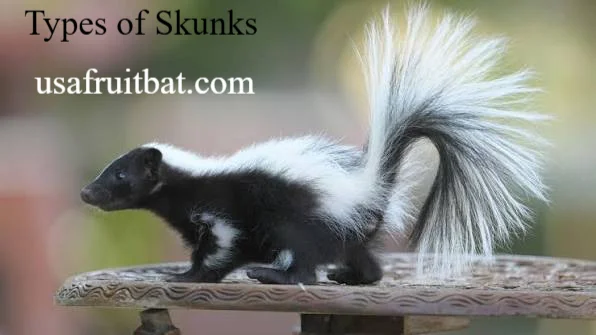
No. Spotted skunks have broken stripes and spots, hog-nosed skunks have a broad white back, and some hooded skunks are almost entirely white. Striped skunks have the classic two stripes, but even their stripes vary in width and length.
Why Do Skunks Have Black and White Fur?
The contrast is a warning signal, called aposematic coloration. Predators that learn to associate the pattern with a foul spray tend to avoid it.
Why Do Skunks Spray, and How Do They Warn Predators?
Skunks spray as a last resort. They have two glands near the base of the tail that produce an oily, sulfur-rich liquid (thiols) they can aim with good accuracy for roughly 10 feet. The supply is limited, and it takes days to refill, so skunks avoid wasting it.
Warning signals typically come first:
- Stamping or scratching the front feet
- Hissing or clicking
- Turning the rear toward the threat
- Raising the tail
- For spotted skunks, a handstand-style display
If you see these signs, back away slowly and give the animal room. If you or a pet are sprayed, the classic tomato juice remedy is a myth. A fresh mixture of hydrogen peroxide, baking soda and dish soap is widely recommended, but keep it away from eyes and don’t store it in a sealed container. If a pet was sprayed in the face or eyes, call a veterinarian.
What Should You Do if Skunks Move Into Your Yard?
Don’t handle them yourself, and address what attracts them first.
- Remove food sources: secure trash, bring pet food inside, and reduce grubs in the lawn
- Block access: seal gaps under decks, sheds and porches
- Use one-way exclusion doors only after confirming no young are inside; dependent young are common in spring and early summer
- Avoid poisons and traps unless local rules allow and you know how to use them safely
Rules vary by state, so check with your state wildlife agency before removal. Skunks are among the wild animals that can carry rabies, so avoid contact, and call a licensed wildlife control operator if a skunk seems disoriented, aggressive, or active in daylight.
FAQ Section
Types of skunks with pictures
The best pictures come from trusted sources such as state wildlife agencies, the Smithsonian’s National Zoo, or iNaturalist, which shows photos by location. Look for four looks: two white stripes (striped), broken spots (spotted), a very long tail with a neck ruff (hooded), and a bare snout with a solid white back (hog-nosed).
Types of skunks in the world
The world has 12 skunk-family species. There are striped skunks, spotted skunks and hog-nosed skunks in the Americas, plus two stink badger species in Southeast Asia. South America has only hog-nosed skunks.
Striped skunk
The striped skunk (Mephitis mephitis) is the most common skunk in the United States. It has a black body with two white stripes and a white head cap, and it lives across southern Canada, the US and northern Mexico. It eats insects, grubs, eggs and small animals, and often dens under decks or in burrows.
Types of skunks in North America
The main ones are the striped, spotted, hooded and hog-nosed skunks. The striped skunk is the most widespread, the spotted skunk splits into eastern and western species, and the hooded and hog-nosed skunks are mostly found in the Southwest and Mexico.
Hooded skunk
The hooded skunk (Mephitis macroura) has a very long tail, a ruff of fur around the neck, and a color pattern that varies from two stripes to almost all white. It lives from the US Southwest, including parts of Arizona, New Mexico and Texas, south through Mexico to Central America.
How many types of skunks are there
There are 12 species in the skunk family: 2 striped skunks, about 4 spotted skunks, 4 hog-nosed skunks and 2 stink badgers. The spotted skunk count is debated, so you may see slightly different totals depending on the source.
Author Bio: Hamid Ali is a wildlife and nature writer covering skunk species, animal behavior, habitats, and wildlife identification. He focuses on clear, research-based insights that help readers better understand North American wildlife and coexist safely with wild animals.
Author Name: Hamid Ali
Email: johanharwen314@gmail.com
Also Read: